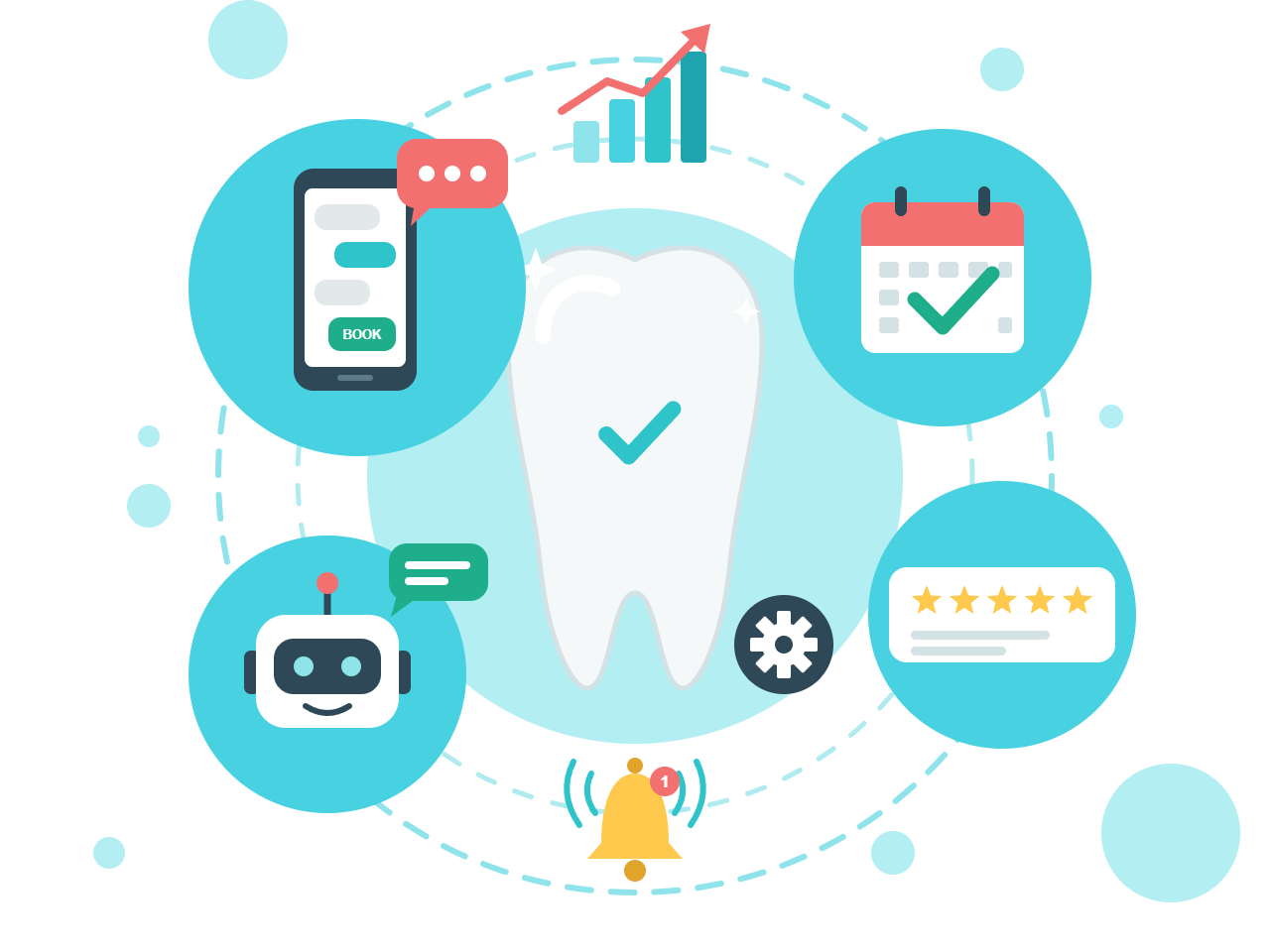
Automation of Your Practice's Processes Is Key to Scaling
How Automation Is Helping Dental Practices Scale
The fastest-growing dental practices aren't hiring their way to growth. They're automating the front office so every call, appointment, and treatment plan turns into revenue, where each win feeds the next.
Most practices hit a ceiling that has nothing to do with clinical skill. The phones ring during lunch and nobody answers. Patients forget appointments. Treatment gets recommended and never scheduled. Happy patients never leave a review. Each leak looks small on its own. Together, they cap how big a practice can get, no matter how much it spends on marketing.
Automation removes that ceiling. It doesn't replace your team. It catches the work that falls through the cracks when your team is busy taking care of the patients in the chair.
The four leaks that cap a practice's growth
Most practices already generate enough demand to grow. The problem is how much of it leaks out before it becomes production.
Leak | What the numbers say | What it costs |
|---|---|---|
Missed calls | Practices miss roughly 30–38% of calls during business hours (Dental Economics) | A new patient is worth about $850–$1,300 in year one and often $8,000+ over their lifetime |
No-shows and cancellations | The 2025 industry average was a 6.9% no-show rate and a 12.9% cancellation rate (Planet DDS) | Roughly 1 in 5 booked slots is at risk of going empty |
Unfinished treatment | Only 47% of treatment plans created in the first half of 2025 were finished by year end (Planet DDS) | More than half of diagnosed, accepted dentistry never turns into production |
Lapsed recall | Only 63% of hygiene patients were reappointed in 2025 (Planet DDS) | Over a third of your existing patients walk out without a next visit booked |
None of these are clinical problems. They're follow-up problems. A busy front desk can't call every missed number back, chase every unscheduled treatment plan and text every overdue hygiene patient while also checking people in. That's exactly the kind of repetitive, time-sensitive work automation does well.
Seven automations that plug the leaks
Each of these runs in the background, 24/7, and costs a fraction of a new hire.
1. Missed-call text-back
When a call goes unanswered, the caller gets a text within seconds: "Sorry we missed you, how can we help? Tap here to book." A caller who would have dialed the next dentist on Google is now in a conversation with you. This is the single fastest win for most practices, because it recovers new patients you were already paying to attract.
2. AI phone and chat assistants
An AI receptionist answers overflow, lunch-hour and after-hours calls, answers common questions, and books appointments directly into your schedule. A website chat assistant does the same for visitors who would rather type than call. Your team stops being the bottleneck for new patient intake.
3. Online self-scheduling
Letting patients book, reschedule and cancel online captures the people who browse at 10 p.m. and never call. It also turns would-be no-shows into reschedules, because changing an appointment no longer requires a phone call.
4. Automated reminders and confirmations
This is the most-studied automation in dentistry. One vendor-run study tracked about 21.6 million appointments at 491 practices and found automated reminders cut no-shows by about 23% at dental practices, adding an average of $31,457 in production per practice (Dentaltown). Add a waitlist that texts patients when a slot opens, and cancellations get refilled the same day.
5. Recall and reactivation campaigns
Automated texts and emails find patients who are overdue for hygiene or have open treatment plans and invite them back with a one-tap booking link. This is revenue you've already earned the right to. No ad spend required.
6. Review requests and reputation management
After each visit, happy patients get a short text asking for a Google review. In one survey of 600 U.S. adults, 67% of people looking for a new dentist used online reviews, and Google was the top platform by far (DentistryIQ). A steady stream of fresh five-star reviews makes every other marketing dollar work harder.
7. Marketing funnels with automated follow-up
A lead from a Google or Facebook ad gets an instant response, then a sequence of follow-ups until they book. Without automation, most leads go cold before anyone calls back. With it, every lead gets worked, every time.
Why the gains compound instead of just adding up
One automation gives you a bump. A connected system gives you a flywheel, because each step feeds the next:
Missed-call text-back and AI answering capture more of the demand you already have.
Reminders and self-scheduling make sure those new patients actually show up.
Automated treatment follow-up turns more diagnosed dentistry into completed production.
Post-visit review requests turn those patients into public five-star proof.
More fresh reviews lift your Google ranking and conversion rate, which brings in more calls.
Recall campaigns keep every one of those patients coming back, so your patient base grows instead of churning.
Here's a simple illustration. Say a practice gets 400 calls a month and misses 35% of them, or 140 calls. If 30% of those are new patients, that's 42 potential new patients a month slipping away. Recover just a third of them with text-back and that's 14 extra new patients a month. At a conservative $1,000 in first-year value each, that's about $14,000 a month, or $168,000 a year, from one automation.
Now those 14 patients get reminders, so more of them show up. They get treatment follow-up, so more of their care gets done. They leave reviews, so next month more people call. That's why practices that automate the whole patient journey pull away from those that don't. The growth isn't a straight line. Each month starts from a bigger base.
These figures are illustrative, not a guarantee. Your results depend on your call volume, case mix and how well each step is set up.
Automation should free your team, not replace the human touch
Dentistry runs on trust, and patients can tell when they're talking to a robot that doesn't care. The goal is to automate the repetitive tasks so your team has more time for the conversations that matter.
Automate: reminders, confirmations, missed-call texts, review requests, recall outreach, lead follow-up and after-hours booking.
Keep human: treatment plan conversations, financial discussions, anxious or upset patients, emergencies and complaints.
Always offer a way out: every automated message should make it easy to reach a real person.
Done right, patients don't feel automated. They feel remembered.
Where to start: a practical first 90 days
You don't need to automate everything at once. Start where the money is leaking fastest.
Timeframe | Focus | What to set up |
|---|---|---|
Days 1–30 | Stop losing new patients | Call tracking, missed-call text-back, online booking on your website |
Days 31–60 | Fill the schedule | Two-way reminders and confirmations, a cancellation waitlist, recall and reactivation campaigns |
Days 61–90 | Grow your reputation and reach | Automated review requests, ad funnels with instant lead follow-up, AI after-hours answering |
Track four numbers from day one: missed-call rate, new patients per month, no-show rate and Google review count. If those move in the right direction, revenue follows.
Find out what your practice is leaving on the table
The practices growing fastest today aren't working harder. They've built systems that catch every call, fill every chair and turn every happy patient into their next referral.
At DevExec LLC, we build these systems for dental practices: missed-call text-back, reputation management, high-converting websites and marketing funnels that follow up automatically.
Virginia practices: claim your free dental marketing audit. We'll show you exactly where patients are slipping through the cracks and what it's costing you. Visit www.devexecagency.com to get started.
Sources
The economics of missed calls: Quantifying revenue loss in dental practices, Dental Economics (author works for a call-software vendor; benchmarks are estimates)
2026 Dental Industry Outlook: Deep Dive, Planet DDS (2025 no-show, cancellation, reappointment and case completion rates)
Breakthrough Study Shows Impact of Automated Patient Appointment Reminders on Practice Production, Dentaltown (2013 study by vendor Sesame Communications)
Secrets to happy dental patients: Actionable tips from a recent study, DentistryIQ (Dandy / Isurus survey of 600 U.S. adults)